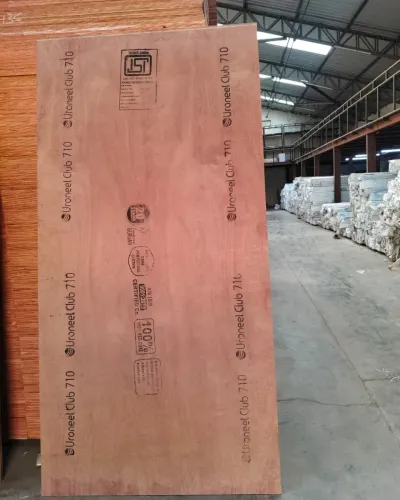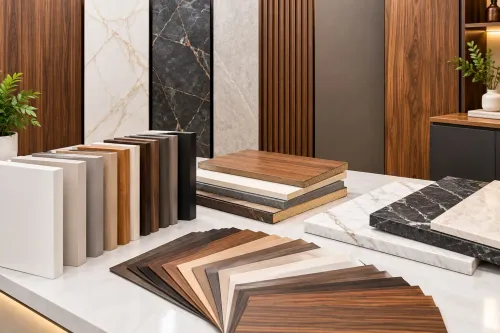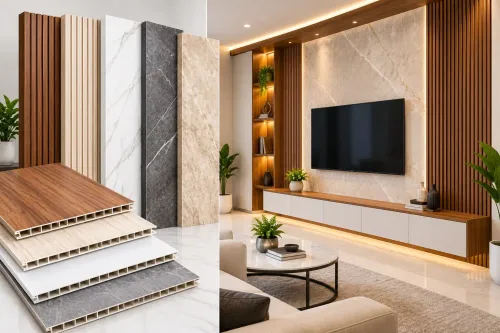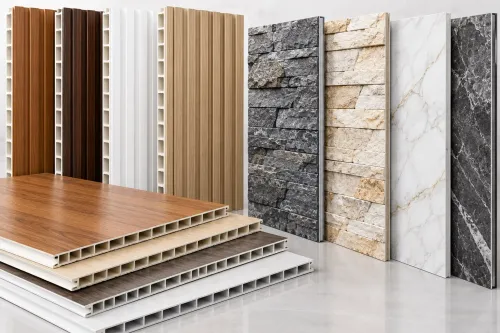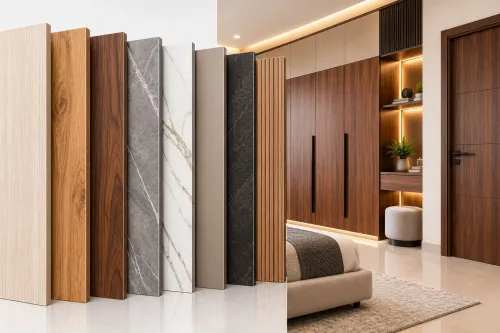
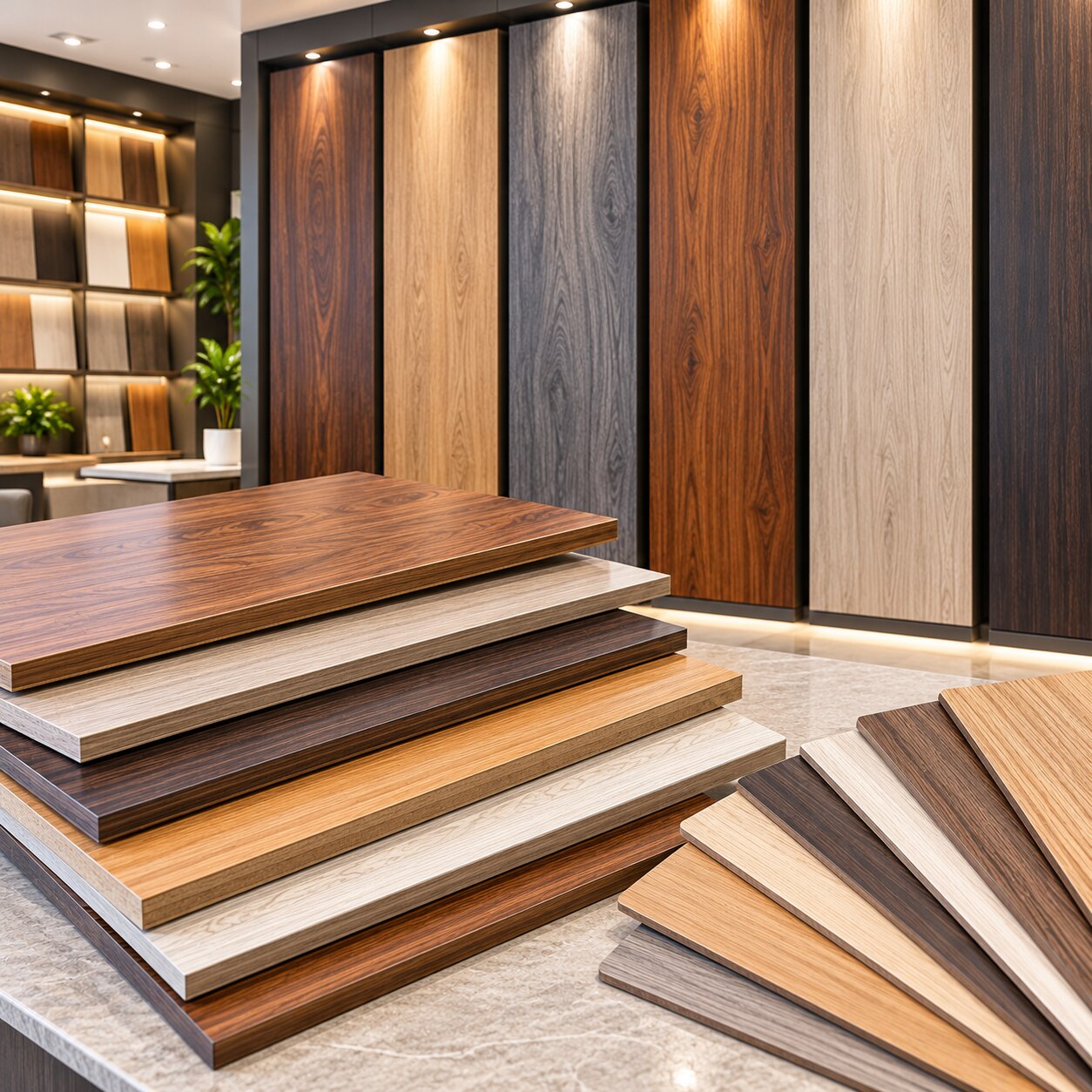
A digitally printed wood pattern can deliver a consistent timber appearance without the selection and refinishing demands of natural wood, but the print alone says little about durability or moisture performance. By comparing the complete sheet construction, installed cost, application, sample quality and installation method, you can decide whether it suits your Pune project.
Key takeaways
- Treat “digital wooden laminate” as a market description, not a performance standard.
- Compare the actual core, overlay, thickness, edge treatment and warranty before ordering.
- Approve a full-size sample under your interior’s lighting before buying sheets.
- Calculate sheets, wastage, adhesive, labour, edges, transport and substrate repairs together.
What digital wooden laminate is—and what it is not
A digital wooden laminate carries a digitally printed wood image beneath an overlay or protective coating. “Digital wooden laminate” is a market description, not a performance standard: the same image may appear on HPL, compact laminate, decorative paper, PET or PP film, or foil bonded to MDF or particleboard.
Specify the face, coating, thickness, substrate, adhesive and intended use.
- Veneer is a real, thin wood layer with natural knots and shade variation; it can be sanded, stained and refinished. A digital print offers repeatable colour but cannot be repaired that way.
- Solid wood gives authentic grain, depth and repairability, but costs more and moves with moisture.
- Melamine is resin-impregnated printed paper fused to a board; digital laminate may use a sharper image and stronger construction.
- Vinyl film is a flexible surface wrap, not automatically equivalent to a bonded HPL.
- Porcelain resists heat, water and scratching better, but feels less like wood and demands specialist cutting.
- Ordinary textured laminate may imitate generic grain; digital printing allows detailed species, knots and wider visual control.
| Option | Visual result | Practical trade-off |
|---|---|---|
| Digital laminate | Controlled, repeatable wood image | Check coating, edges and substrate |
| Veneer | Natural variation | More selection and finishing work |
| Textured laminate | Embossed grain with simpler pattern | Often lower visual realism |
| Vinyl film | Printed wrap | Vulnerable edges and lifting if poorly bonded |
| Porcelain | Wood image on rigid ceramic | Durable but costly to cut and install |
The trade-off is worthwhile for digital wooden laminates for interiors in Pune when you need consistent wood look laminate for interiors across many shutters or panels, and installed maintenance savings exceed alignment, edge-treatment and wastage costs. Inspect a full-size sample under warm and cool lighting before committing.
Where it earns its place in a Pune interior
Use digital wooden laminate on vertical, frequently handled surfaces: wardrobe shutters, kitchen shutters, TV units, office cabinetry, reception counters, wall panels and doors. Furniture tops also suit it when the selected grade, edge detail and substrate tolerate impact, heat and moisture.
The digital wooden laminate benefits in Pune are easiest to justify where you need repeatable colour, quick cleaning and less polishing than natural wood.
Do not judge the image alone: compare an HPL bonded to stable plywood with a thin printed film on MDF, because print technology does not prove scratch resistance, moisture resistance or service life.
| Option | Strength compared with digital laminate | Choose it when |
|---|---|---|
| Veneer | More natural variation; needs finishing and careful maintenance | You want authentic timber character and accept selection, polishing and repair work |
| Acrylic | Deeper gloss and stronger colour impact; shows fingerprints and scratches readily | A sleek, reflective kitchen or feature panel matters more than forgiving maintenance |
| Membrane finish | Seamless routed profiles; vulnerable to heat and lifting at edges | You need shaped shutter fronts without visible joints |
| Paint | Easiest colour changes and local recoating | Walls or low-abuse furniture need flexibility |
| Solid wood | Best repairability and tactile depth; costs more and moves with humidity | The timber itself is the design feature |
For Pune kitchens, use it on shutters and side panels, not beside an unsealed sink or hob without protection. Low-sheen textures hide handling marks better than dark gloss, but deep texture traps grime. Inspect a full-size sample under the actual warm and cool lighting before approving wall panels, doors or adjoining shutters.
How to approve the look before ordering sheets
Approve a dated, full-size mock-up before ordering. A small colour card hides grain repeats, edge behaviour and alignment problems that become obvious across a wardrobe, wall panel or furniture run.
- View the sample in warm 2700–3000 K light, neutral daylight and the actual room lighting. Check base colour, print sharpness, texture, gloss, fingerprints and whether the wood image still looks convincing from two metres away.
- Place two or three sample sheets side by side and end to end. Mark repeated knots, identical cathedral lines and abrupt changes in tone; reject a layout that puts the same feature on adjoining shutters.
- Draw the elevation with panel widths, heights, grain direction and joint positions. Specify whether grain must run continuously across doors, drawer fronts, wall panels and exposed furniture sides, and identify where sheets can be rotated.
- Inspect a cut edge and corner, not only the face. Confirm that the approved face works with the selected edge band, handle drilling and routed profile without exposing a mismatched core.
- Record the manufacturer, finish code, sheet thickness, lot number and approved sample. Ask for a written shade and print-repeat matching process; do not assume a later lot will match.
For digital laminate sheets in pune, request the complete sheet specification, substrate and intended application alongside the visual approval. Keep one signed control sample on site, and require the fabricator to compare every delivered sheet against it before cutting. That prevents a colour mismatch from becoming installed waste.
Why substrate and installation decide the result
A calibrated, flat substrate matters more than a premium print. For Pune interiors, choose a moisture-resistant plywood or board specified for interior laminating, then verify that it is dry, dust-free and within the manufacturer’s flatness tolerance. Moisture-resistant does not mean waterproof.
| Board | Best fit | Main risk |
|---|---|---|
| Moisture-resistant plywood | Shutters, counters and wall panels | Veneer-core telegraphing through a thin laminate |
| Moisture-resistant MDF | Routed profiles and stable cabinet faces | Swelling if an exposed edge gets wet |
| Particleboard | Dry, budget cabinetry | Edge crumble and faster damage after wetting |
Use the adhesive system named for the exact laminate and substrate; do not substitute ordinary woodworking glue or rely on scattered contact adhesive for a large face. Apply full, even coverage, respect open time, and press from the centre outward with uniform pressure.
Trapped air creates blisters, while damp board sealed under laminate can swell later.
- Seal every cut edge, sink cut-out and joint with the specified edge band, laminate strip or moisture-resistant coating. Do not leave the core exposed.
- Route with sharp cutters, stable support and a final light pass. Excess heat or a blunt bit chips the face and opens the edge.
- Leave the movement and installation clearances stated by both manufacturers; do not force panels against damp walls or trap wet material.
- For a curved front, confirm postforming grade, minimum radius, forming temperature or method, and grain direction. A general-purpose sheet can crack, whiten or delaminate at the bend.
- Inspect the finished panel for lifting corners, open joints, bubbles and chipped routing before it reaches a sink, utility area, balcony or poorly ventilated wall.
Calculate the installed cost and buy with evidence
A sheet price is not the project cost. Add substrate, adhesive, matching reverse face, edge treatment, cutting, pressing, grain-alignment wastage, hardware removal and installation labour; divide the total by usable square metres, not purchased sheets.
| Option | Cost and upkeep to compare | Repairability and evidence |
|---|---|---|
| Digital HPL on plywood | Higher fabrication cost; wipe with a soft cloth and mild cleaner | Local damage is difficult to disguise; request EN 438 or applicable Indian test data |
| Thin printed film on MDF | Lower face cost; moisture at edges can cause swelling | Peeling or dents usually mean panel replacement; verify board and film specifications |
| Natural veneer | Selection and polishing add labour; finish needs protection | Small damage can be refinished; confirm veneer thickness and clear-coat system |
| Solid wood | Highest movement, finishing and installation effort | Sanding and refinishing are possible; obtain moisture and finish-care guidance |
Ask a wooden laminate supplier in Pune to quote each cost line and state the expected service life for your exact application, not a generic product claim. Whether you buy from National Veneer & Ply or another source, retain the approved control sample and lot number.
- Dated, full-size sample with thickness and tolerance
- Technical data naming face, overlay or coating, substrate and adhesive
- Intended-use classification, cleaning instructions and chemical-resistance results
- Postforming limits, warranty exclusions and replacement process
- Batch identification and written shade or print-repeat matching procedure
Do not use flooring AC wear classes to justify a furniture or wall purchase; EN 13329 applies to flooring, while decorative laminates need relevant EN 438 or Indian-specification evidence.
Related product
 | Laminates Digital laminates, also known as decorative laminates or digital print laminates, are a type of surfacing material used in interior design and... View product → |
Frequently asked questions
What is digital wooden laminate?
It is a digitally printed wood image protected by an overlay or coating. The construction may use HPL, compact laminate, decorative paper, PET, PP film or foil bonded to a board.
Where do digital wooden laminates work well in Pune interiors?
They suit applications where you want a consistent wood appearance without relying on natural timber grain. Choose the construction based on the surface, moisture exposure, impact and cleaning demands.
How can you approve the laminate appearance before ordering?
Inspect a full-size sample in the actual room, under daylight and artificial lighting. Check colour, grain scale, repeat pattern, sheen and edge appearance before approving sheets.
What determines the installed cost of digital laminate sheets?
Include the laminate, substrate, adhesive, cutting, wastage, edge treatment, labour, transport and substrate repairs. Compare written quotes using the same thickness, area and scope.
Keywords