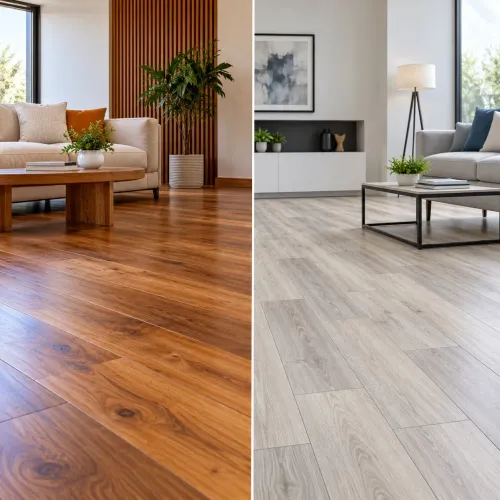
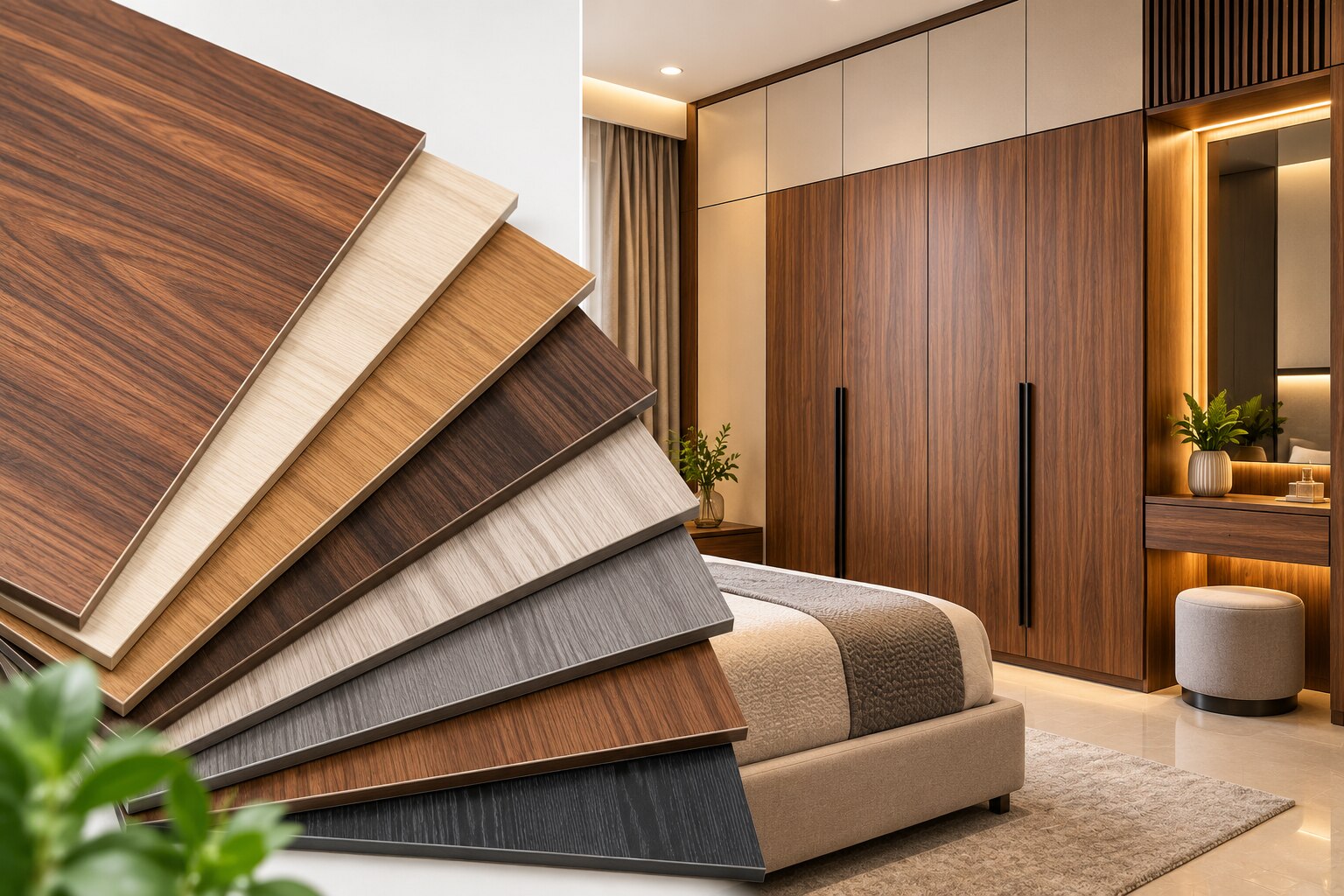
A wood-look surface can be a digitally printed HPL sheet, a paper foil, a melamine-faced board, or a plastic film, and those products do not perform the same way. By checking the layer construction, print quality, technical classification, supply terms and installation conditions, you can choose the right material for a Pune project and avoid failures caused by moisture, heat, poor bonding or mismatched sheets.
Key takeaways
- Check the printed grain scale, colour match and repeat pattern before ordering.
- Compare laminate against veneer, PVC and other surfaces by use, not appearance alone.
- Confirm sheet size, thickness, finish, quantity, lead time and installation requirements in writing.
- Store sheets flat in a dry indoor space before digital laminate installation.
How a digital wooden laminate is constructed and manufactured
A digital wooden laminate starts with a high-resolution wood image, not a slice of timber. Inkjet printing places that image on decorative paper, allowing controlled grain scale, colour and repeat patterns instead of the fixed cylinder repeat used for conventional gravure-printed laminate.
The printed paper becomes one layer in a pressure-built sheet. Its usual construction is:
- A transparent overlay protects the image from abrasion, stains and cleaning.
- The resin-impregnated decorative paper provides the visible wood pattern.
- Kraft-paper core layers create thickness, stiffness and impact resistance.
- A resin-treated backing or balancing sheet helps control movement after bonding.
Manufacturing follows a defined sequence:
- Select and colour-manage the image, then approve a physical proof for tone, grain direction and repeat.
- Print the design at production resolution and treat the paper with thermosetting resin.
- Stack the overlay, decorative sheet, kraft layers and backing in the specified order.
- Press the stack under heat and pressure until the resin cures and bonds the layers into a rigid sheet.
- Trim the sheet, inspect its surface and check dimensions, colour, gloss, thickness and defects.
A digital wooden laminate in Pune may instead refer to printed foil, PET film, melamine-faced board or direct-to-board UV printing. Ask for the construction and classification: a digitally printed HPL has different heat resistance, edge treatment, abrasion performance and postforming limits from these look-alike products. Image realism does not prove durability.
How to compare the wood image with veneer, PVC and other surfaces
A convincing wood image does not make every surface equivalent. Confirm whether the sample is a digitally printed HPL sheet, paper foil, melamine-faced board, PET film or direct-to-board print; thickness, edge treatment, heat resistance and wear performance will differ.
| Surface | What the wood image means | Practical difference |
|---|---|---|
| Digital wood laminate | Inkjet-printed image with controlled grain scale and repeat | Select the overlay, texture, wear grade and postforming grade separately |
| Conventional wood-grain laminate | Repeating gravure-printed design | Repeats can be easier to spot across doors or panels |
| Natural veneer | Thin slice of real timber | Grain varies naturally; joints, colour matching and sealing require more control |
| PVC sheet | Printed or embossed plastic film | Flexible and moisture-tolerant, but texture, heat resistance and repairability depend on the film |
| Acrylic | Printed or coloured polymer sheet | Deeper gloss and colour, but scratches and reflections can be more visible |
| Melamine board | Decorative paper fused directly to a board | Fewer edge and repair options than a separate HPL sheet bonded to a substrate |
| Wood flooring | A floor system designed for foot traffic and movement | Do not substitute furniture laminate for flooring wear, locking or moisture requirements |
Judge the appearance from a full-size approved sample, not a catalogue photograph. Check the grain direction, image sharpness, pore alignment, gloss or matte reflection, tactile texture, edge colour and visible repeat.
For wooden laminate applications such as wardrobes, reception counters or wall panels, request sequential sheets from one batch and approve a layout before ordering. A “seamless” design can still repeat. Confirm postforming radius and heating limits before specifying rounded edges.
What to confirm when buying digital laminates in Pune
Ask a digital laminate supplier in Pune to identify the exact product before discussing colour. Confirm whether it is digitally printed HPL, paper foil, melamine-faced board, PET film or direct-to-board UV print; a similar-looking sample does not provide the same thickness, edge treatment, heat resistance, repairability or postforming performance.
| Product | Confirm in writing | Risk if assumed |
|---|---|---|
| Digitally printed HPL | Overlay, resin system, core, thickness and classification | A decorative foil may be mistaken for HPL |
| Postforming HPL | Forming radius, heating method, temperature window and grain direction | A non-postforming sheet can crack, whiten or delaminate |
| Printed board | Board type, face thickness and balancing backer | Doors or panels can warp after fabrication |
For a “buy digital laminates in Pune” order, approve a physical face sample, not a catalogue photograph. For a reception desk, wardrobe run or large door set, request a full-size layout or sequential sheets showing repeat, grain direction, gloss, texture and edge appearance. Record the approved colour, surface code and acceptable batch variation.
- Request the technical data sheet, fire classification where required, abrasion or wear rating, warranty exclusions and recommended adhesive.
- Confirm sheet length, width, thickness, minimum order quantity, stocked or made-to-order status and production lead time.
- Ask whether replacement sheets can be supplied later from the same design and batch.
- Specify the backer or balancing layer and edge treatment.
- Get the number of sheets allocated to your batch.
Whether you buy from National Veneer & Ply or another vendor, keep this signed specification with the purchase order.
Related product
 | Laminates Digital laminates, also known as decorative laminates or digital print laminates, are a type of surfacing material used in interior design and... View product → |
How Pune conditions affect delivery, storage and digital laminate installation
A damp delivery should not go straight onto a wall, door or cabinet. Pune’s monsoon humidity, hot vehicle interiors and air-conditioned rooms can leave sheets with different moisture levels from the substrate, causing swelling, curling or adhesive failure after installation.
- On receipt, inspect the packaging for rain exposure, torn wrapping, crushed corners and trapped condensation. Record sheet size, thickness, batch details and visible damage before signing.
- Store sheets flat on a level, dry support, protected from rain, direct sunlight and hot air. Use the manufacturer’s face-to-face protective arrangement and do not lean sheets against a wall, which can create permanent bowing.
- Acclimatise the sheets and the receiving boards in the installation room for the period specified by the manufacturer. Do not install immediately after damp transport; allow the materials to reach the room’s temperature and moisture condition first.
- Before bonding, make the substrate flat, dry, clean and structurally stable. Remove dust, wax, release agents and loose fibres; sand high spots and fill voids. Unevenness telegraphs through thin laminate, while trapped dirt produces hollow areas and blisters.
- Use an adhesive compatible with the laminate, substrate and expected heat exposure. Follow its spread rate, open time and curing instructions, then apply even pressure to expel air.
- For doors, shutters and furniture panels, laminate the reverse face with the specified balancing layer or a technically compatible material. A decorative face alone can bow as humidity changes.
- Seal exposed edges where the design requires it, and protect fresh digital laminate installation from water, heat and impact until the adhesive has cured. Use only the supplied cleaning instructions afterwards.
Where to use the material and how to specify its long-term performance
Choose the grade by abuse and exposure, not by the realism of the wood image. Wooden laminate applications such as cabinet shutters and wardrobes need a different specification from worktops, lift interiors or fire-sensitive wall cladding.
| Application | Performance specification | Edge and backing requirement |
|---|---|---|
| Vertical furniture, doors and partitions | Decorative HPL with the required scratch and wear classification | Seal exposed cut edges; use a compatible reverse-side balancer on doors and shutters |
| Worktops, reception counters and desks | Higher abrasion, impact and heat resistance; specify postforming grade only if the supplier states the forming radius and temperature window | Form or seal edges as approved; balance the underside |
| Wet-adjacent cabinets and washroom panels | Moisture-resistant substrate, sealed joints and an adhesive suited to the exposure | Protect every cut edge; do not rely on laminate alone to waterproof a panel |
| Retail fixtures, lift interiors and busy corridors | Higher wear and cleanability performance, with a matching edge solution | Use durable edge bands or bonded laminate returns at impact zones |
| Fire-sensitive walls, ceilings and columns | Obtain the exact fire classification and test report required by the project, such as EN 13501-1 documentation | Confirm whether the edge system and substrate are included in the tested assembly |
A single-sided face can bow when temperature and humidity differ across the panel. For digital wooden laminate in Pune, specify the same or technically compatible balancing layer on the reverse, plus batch tolerance and approved sample.
Clean with a soft cloth and pH-neutral detergent; abrasive pads, bleach, acetone and standing water can dull or damage the surface.
Frequently asked questions
How is a digital wooden laminate made?
A high-resolution wood image is inkjet-printed onto decorative paper, then combined with laminate layers and pressed into a finished surface. Digital printing allows controlled grain scale, colour and repeat patterns.
How does digital laminate compare with veneer and PVC?
Digital laminate offers printed design control and repeat consistency, while veneer uses a real timber slice and PVC is a polymer surface. Compare appearance, moisture exposure, edge treatment, repairability and installation method for the specific application.
What should you confirm before buying digital laminates in Pune?
Confirm the sheet dimensions, thickness, surface finish, design reference, colour sample, quantity, availability, delivery schedule, packaging and installation instructions with the supplier.
How should digital laminates be delivered, stored and installed in Pune?
Plan delivery around site access and interior humidity, inspect packs for damage, and store sheets flat in a dry indoor area. Follow the adhesive, substrate preparation, pressing and edge-finishing instructions supplied for the chosen laminate.
Keywords