Choosing between imported exotic veneer and local veneer requires more than comparing colour or price per square metre. You will be able to judge the species, cut, usable yield, panel construction, climate risks, documentation and replacement risks before approving a furniture veneer for a Pune project.
Key takeaways
- Compare veneer by species, core, thickness, finish and documentation—not origin alone.
- Choose imported veneer for distinctive appearance when its premium supports the design.
- Seal every veneer panel against Pune’s seasonal moisture changes.
- Approve bundles only after checking matching grain, defects, moisture and batch details.
What “exotic veneer” means, and how local species compare
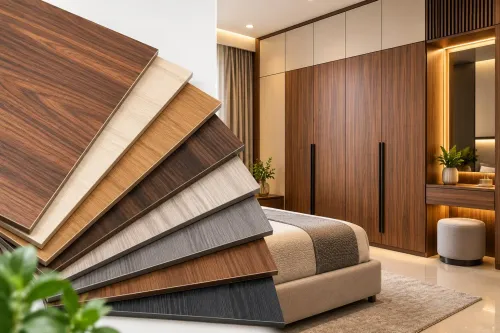
“Imported exotic veneer” describes origin or supply chain, not a performance grade. Walnut, ebony, teak, eucalyptus, oak and zebrano may enter through an overseas supplier, while Indian teak, mango, neem, sheesham, rubberwood and eucalyptus are locally available. Exotic wood veneer for furniture is usually chosen for appearance, not guaranteed durability or stability.
| Source | Examples | What to inspect |
|---|---|---|
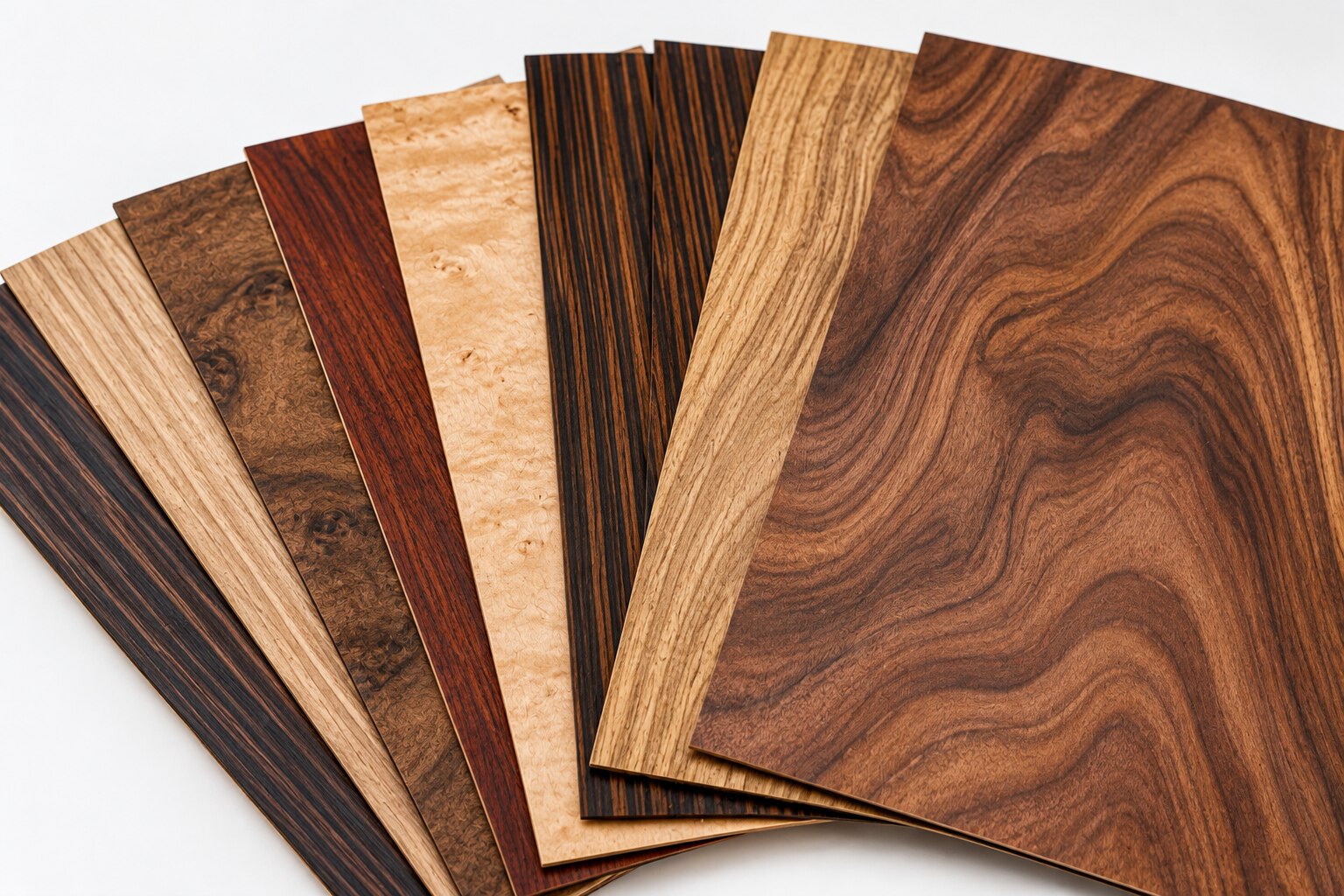
| Imported | Walnut, ebony, teak, eucalyptus, oak, zebrano | Brown, grey or near-black colour; open or tight pores; straight, ribbon, fiddleback or burl figure; sapwood contrast and colour variation |
| Local | Indian teak, mango, neem, sheesham, rubberwood, eucalyptus | Grain character, cathedral figure, pore size, sapwood and consistency across available sheets |
Natural veneer is real wood peeled or sliced from a log. Reconstituted or engineered veneer is made from processed wood layers formed into a controlled grain pattern. Rotary-cut veneer is peeled around the log, producing wider sheets and stronger cathedral patterns.
Quarter-cut veneer is sliced through the quartered log for straighter grain and, in suitable species, ribbon figure. Crown-cut veneer is flat-sliced to create arching crown patterns.
A species name alone is insufficient: slicing changes pattern and sheet width. Sliced veneer shows more recognisable board-like grain, while rotary cutting creates broader, more pronounced cathedral patterns. Compare the cutting method when assessing local veneer versus imported veneer.
Where imported veneer earns its premium—and where it increases cost
Imported exotic veneer benefits in Pune when a project needs a distinctive colour, pore pattern or figure across a large visible surface. Walnut, zebrano or figured teak can give statement doors, tabletops, wardrobes, reception desks and feature furniture a look that a local alternative cannot reproduce.
The advantage is visual and specification-based, not proof of better structural performance.
| Match | Appearance | Requirement |
|---|---|---|
| Book-matching | Opened sheets mirror each other | Two consecutive leaves |
| Slip-matching | Leaves sit side by side without mirroring | Consistent grain direction |
| Sequence-matching | Consecutive sheets continue the figure | A full flitch or coordinated bundle |
A small sample hides sapwood, colour shifts, end splits and defects. Approve a full-size panel instead. Calculate usable finished area after trimming, jointing, defect removal and matching waste; nominal square metres can overstate the area that reaches the furniture.
Imported exotic veneer versus local veneer in pune becomes a cost decision when freight, exchange-rate movement, installation labour and minimum orders enter the quote. Customs delays extend procurement, replacement stock may be unavailable, and a later repair may not match the original batch.
- Choose local veneer for phased production, smaller quantities or furniture needing quick replacement.
- Choose imported veneer when the specific figure, colour or continuous sequence justifies higher yield loss and longer replenishment.
- Ask for the full flitch or coordinated bundle, batch identification, lead time and replacement options before approving the design.
How Pune’s moisture cycle affects both imported and local veneer
Neither imported nor local veneer is automatically the stable choice for Pune furniture. A humid warehouse, sealed transport package, air-conditioned room and naturally ventilated interior impose different moisture conditions; rapid change can cause bubbling, cracking, joint opening, edge lifting or panel bowing.
| Factor | Imported veneer | Local veneer |
|---|---|---|
| Stability | Depends on species, cut, thickness and construction | Depends on the same variables |
| Pune risk | Origin does not prevent movement | Local origin does not prevent movement |
| Best specification | Balanced panel, controlled conditioning and sealed faces | Balanced panel, controlled conditioning and sealed faces |
Wood moves mainly across the grain, while movement along the grain is smaller. Grain orientation, veneer thickness, adhesive, substrate and finish on both faces therefore matter more than the label “exotic.” A thin, valuable face veneer on a damp, warped or unsuitable panel can bow, cup or open at the joints regardless of origin.
Build a balanced construction: use a comparable reverse veneer or suitable balancing layer, bonded to a flat, moisture-appropriate plywood or MDF core. Press at the adhesive maker’s specified pressure, temperature and time, then finish both faces and seal exposed edges.
Condition the veneer, core panels and adhesives in the workshop before pressing; do not use materials straight from a humid warehouse or transport packaging. Set the conditioning target from the building’s intended indoor service conditions, including air-conditioning, rather than outdoor monsoon or dry-season weather alone.
What to check before approving a veneer bundle or furniture panel
Approve the actual construction, not a photograph. For an imported exotic veneer versus local veneer in Pune, request these details in writing:
- Botanical name, country of harvest and country of supply
- Nominal veneer thickness, sheet length and width, and usable sheet size after trimming
- Moisture condition, slicing method and cut direction
- Bundle, flitch or batch identification
- Book-matched or sequence-matched status
- Backing type, jointing method and adhesive specification
| Compare | What to inspect | Reject or revise if |
|---|---|---|
| Veneer thickness | Face and reverse sheets against the specified thickness | Thickness varies enough to affect pressing or edge levels |
| Grain and sequence | Direction, figure continuity and sheet order across the door or tabletop layout | Sheets break the intended match or reverse direction |
| Joint quality | Tight, straight joints without gaps, overlaps or loose fibres | Joints open under raking light |
| Panel construction | Core, backing, edge treatment and finish on the approval panel | The sample is only a loose veneer sheet |
Ask for a full-size approval panel showing the actual jointing, finish system, edge treatment and core. Plan yield from usable area, allowing for trimming, defects, sapwood, jointing and matching waste; continuous faces need reserve sheets from the same batch.
Check CITES requirements when the exact species or genus, country, product form and route trigger permits or certificates. An ISPM 15 mark proves treatment of imported solid-wood packaging, not sustainable sourcing or legal harvest of the veneer.
A Pune buying decision: choose the supply route, not just the species
Choose the supply route against the furniture brief, not the species name. The imported exotic veneer benefits in Pune are mainly visual: a particular colour, figure, pore pattern, matching sequence or statement effect that justifies higher yield loss and longer replenishment.
| Decision factor | Imported veneer | Local veneer |
|---|---|---|
| Visual brief | Specific figure, colour or species is central | A broad wood appearance meets the design |
| Panel scale | Large doors, tabletops or feature panels need coordinated sheets | Smaller panels reduce matching waste |
| Quantity | The project can absorb minimum orders and reserve stock | Small or phased quantities are required |
| Replacement risk | Repairs can wait for the same batch | Fast replacement and serviceability matter |
| Schedule and exposure | Lead time and conditioning are planned | Quick supply and a familiar chain reduce risk |
This local veneer versus imported veneer decision also depends on environmental exposure. Imported origin does not guarantee stability; specify the core, adhesive, balanced construction and finish for Pune’s moisture cycle. For any imported veneer supplier in Pune, request nominal and usable area, batch identification, lead time, replacement options, and the core and adhesive specification.
National Veneer & Ply is one supplier a buyer can approach for this comparison; judge the offer by samples, technical details and batch continuity, not by an imported range alone.
Approve in this order: define the look, inspect a full-size panel, verify documents, condition materials, approve the construction, and reserve replacement sheets.
Related product
 | Imported WoodenExotic Veneer Imported WoodenExotic Veneer View product → |
Frequently asked questions
What does imported exotic veneer mean?
It describes the veneer’s origin or supply chain, not a performance grade. Imported walnut, ebony, oak or zebrano is not automatically more durable or stable than local veneer.
When does imported veneer justify its higher cost in Pune?
It earns its premium when a distinctive grain, colour or figure is central to the design and the supplier can provide consistent matching. It adds cost through freight, import handling, longer lead times, wastage and replacement difficulty.
How does Pune’s moisture cycle affect imported and local veneer?
Both types respond to changes in humidity. Use a suitable substrate, acclimatise panels, balance the construction and seal all faces and edges to reduce cupping, cracking and joint movement.
What should you check before approving a veneer bundle or furniture panel?
Check species, veneer thickness, sheet dimensions, moisture condition, grain matching, colour variation, open defects, repairs, backing, substrate, finish sample, batch details and replacement terms.
Keywords