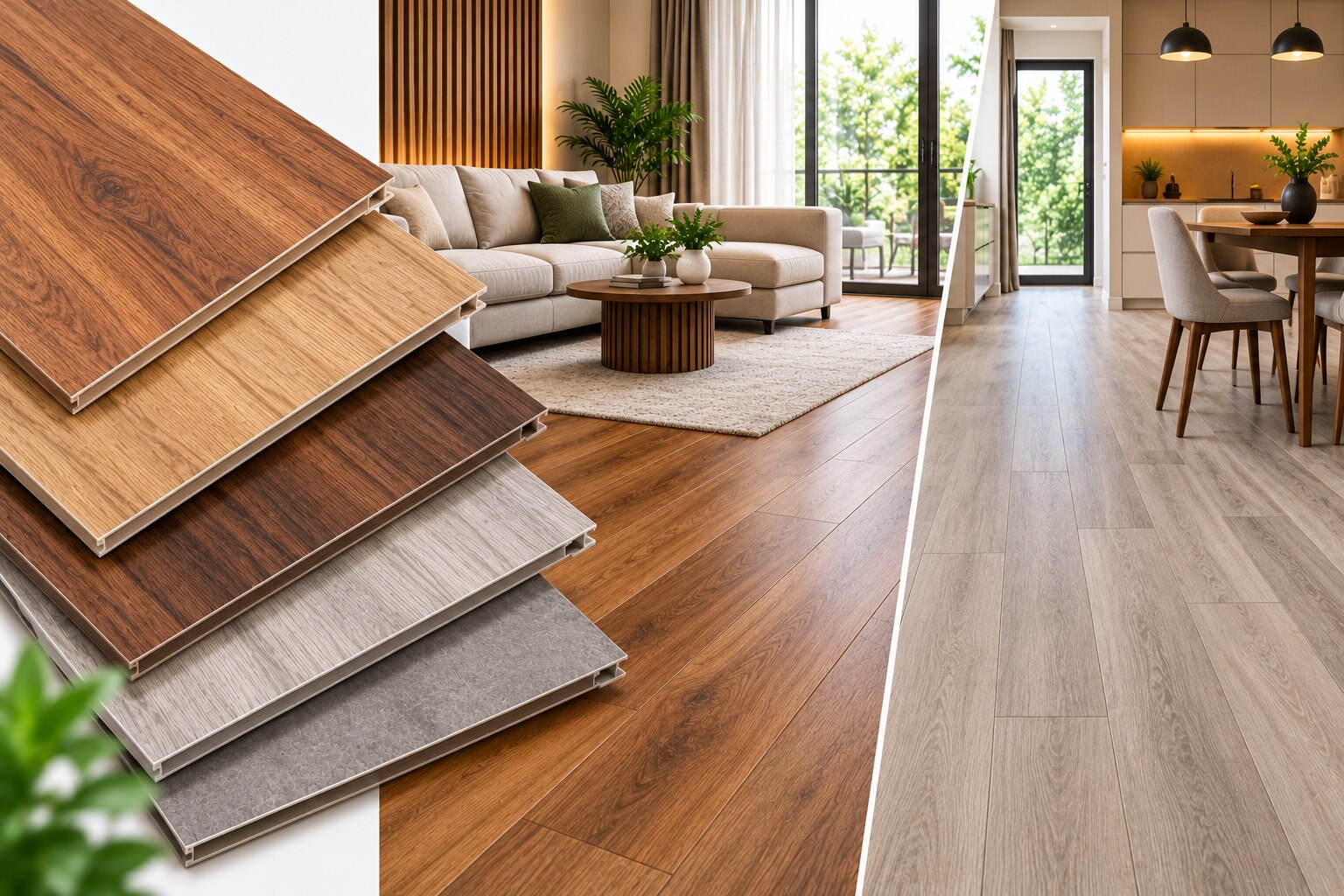
A flooring rate quoted per square foot rarely tells you the full cost or scope of the work. By the end, you will know which materials, preparation tasks, installation items and documents to include when comparing flooring quotations for a Pune property.
Key takeaways
- Demand measured area, wastage, installation, trims, adhesives and taxes as separate quotation lines.
- Compare solid wood, engineered wood, laminate and vinyl by moisture tolerance and repair options.
- Check vinyl plank wear layer, thickness, dimensions, acoustic backing and installation method.
- Approve handover only after checking joints, edges, levels, cleaning and spare material records.
What a complete flooring quotation should include
A complete quotation for wooden and vinyl flooring in Pune must show every cost from measured floor to finished handover, not only the product rate. It should state the calculated area in square feet, plank or board quantity, wastage allowance, and the amount payable for each item.
- Flooring planks, boards or tiles, with product name, size, batch or shade
- Underlay or moisture barrier, where the system requires it
- Skirting, trims, transition profiles and stair nosings
- Adhesives, primer and other installation consumables
- Delivery to site
- Installation labour
- Subfloor preparation, including the stated scope of cleaning, crack repair and levelling
Ask the supplier to mark each line as included, excluded or provisional. Levelling, crack repair, removal of old flooring and shifting furniture are separate charges unless the quotation explicitly includes them. A swept concrete slab is not automatically ready for installation; the scope should identify moisture checks, surface preparation and any moisture mitigation.
“Flooring: ₹___ per square foot” is inadequate for procurement comparison because two suppliers can quote the same material rate while charging different amounts for wastage, underlay, skirting, profiles, labour and preparation. Compare the complete installed cost, then request the technical sheet, installation instructions, maintenance guidance, warranty exclusions and subfloor-check record before paying the final amount.
How solid wood, engineered wood, laminate and vinyl compare
Solid wood suits dry rooms where long-term refinishing matters. Engineered wood offers real timber appearance with better dimensional stability. Laminate suits a cost-sensitive, dry area, while vinyl plank is the safer choice for routine spills and damp cleaning.
| Option | Construction and service life | Repairability, moisture and maintenance |
|---|---|---|
| Solid hardwood | Timber throughout; long service life when protected from moisture and refinished | Sand and refinish several times; poor moisture tolerance; sweep, dry-mop and wipe spills promptly |
| Engineered wood | Real hardwood wear layer over cross-laminated wood layers; long service life, depending on wear-layer thickness | Limited sanding; more stable than solid wood but not waterproof; control humidity and use timber-safe cleaning |
| Wood-look laminate | Printed décor layer over a wood-fibre core; replaceable planks, with a shorter service life than timber when edges wear | Cannot be sanded; vulnerable at joints and swollen edges; dry-clean and wipe spills quickly |
| Vinyl plank | PVC wear layer, printed décor film and flexible or rigid core; service life depends on wear layer, traffic class and care | Replace damaged planks if the system allows; handles routine moisture better than timber products; use manufacturer-approved cleaner and prevent grit damage |
Do not choose by plank thickness alone. Acoustic performance comes from the complete floor and ceiling assembly, including underlay, so request a tested ΔLw or IIC result for that assembly rather than relying on “wooden” or “SPC” claims.
For bedrooms and living rooms, compare appearance and foot comfort; for kitchens, entries and spill-prone areas, prioritise moisture tolerance and joint protection.
What to check in wood-look vinyl plank specifications
A wood-look vinyl plank is usually LVT, SPC or WPC—not timber with a vinyl coating. Its specification reveals the product’s construction, likely comfort, durability and installation requirements.
Request these wood vinyl flooring details in writing:
- Plank length and width
- Total plank thickness
- Wear-layer thickness
- Printed décor layer
- Surface texture and protective treatment
- Core material
- Backing construction
- Attached underlay, if supplied
Total thickness does not prove abrasion resistance. A thicker SPC plank can still have a thinner wear layer than a slimmer product, so compare both measurements separately.
| Construction | What it means | Installation |
|---|---|---|
| LVT | Flexible vinyl with décor film, wear layer and backing | Dryback glue-down or specified click system |
| SPC | Rigid stone-polymer composite core with strong dimensional stability | Usually click-lock floating installation |
| WPC | Cushioned wood-polymer core with a more resilient feel underfoot | Usually click-lock floating installation |
Click-lock flooring needs the manufacturer’s movement gaps and compatible underlay; do not add foam beneath a product with attached padding unless permitted. Glue-down vinyl needs the specified adhesive and a smooth, dry, properly prepared substrate.
Use ISO 10874 use classification and ISO 10582 for heterogeneous poly(vinyl chloride) floor coverings as comparison references. Ask for the stated class, warranty exclusions and test data, not just “commercial grade.”
“Waterproof” describes the plank, not an automatically watertight floor. Water can enter through joints, cut edges and penetrations around pipes or cabinets, so sealing and room suitability still matter.
How Pune site conditions change the material and installation plan
Bedrooms and living rooms favour engineered wood or quality laminate for warmth, appearance and underfoot comfort. Kitchens need spill-resistant vinyl with sealed edges; bathrooms need documented wet-area suitability, sealed transitions and protected penetrations, not merely a “waterproof” label.
| Space | Suitable choice | Installation plan |
|---|---|---|
| Bedrooms and living rooms | Engineered wood or laminate | Use an acoustic underlay where permitted; manage apartment sound transmission. |
| Kitchens | Vinyl plank | Seal edges and inspect joints for spills and cleaning water. |
| Bathrooms | Wet-area-rated vinyl | Confirm documentation, sealed transitions and drain-side detailing. |
| Balconies | Exposed-condition-rated flooring | Reject products rated only for indoor use; account for sunlight and monsoon rain. |
| Rentals | Repairable click-lock vinyl | Install quickly and retain spare planks for local replacement. |
| Offices and shops | Commercial-class flooring | Match ISO 10874 traffic classification to footfall and maintenance demands. |
Pune’s monsoon humidity, dust, strong sunlight and poor ventilation make site readiness decisive. Install only over a clean, dry, smooth and sound substrate. Test concrete for moisture and alkalinity under ASTM F710 principles; cure new screed fully, repair cracks, level uneven areas and remove old flooring before laying.
Floating click-lock floors need the product’s specified perimeter movement gap and clearance around cabinets and door frames. Pinning the floor can cause peaking or buckling. Glue-down flooring demands tighter preparation because adhesive telegraphs slab defects.
After wet trades finish and the building is enclosed, acclimatise timber and engineered flooring. Record product moisture content, room humidity and subfloor moisture; delivery alone is not acclimatisation. Store and install vinyl within the manufacturer’s temperature range, because temperature changes can move the material.
How to compare suppliers and approve the handover
Approve the order only after the quotation and handover describe the complete installed floor, not just a square-foot material rate. Ask a wooden flooring supplier in Pune or vinyl flooring supplier in Pune for a line-by-line scope covering:
- Product construction, plank or tile size, batch or shade, measured area and wastage allowance
- Skirting, transition profiles and stair nosings
- Adhesive, underlay and moisture mitigation
- Delivery, installation labour and floor preparation, including levelling, crack repair or old-floor removal
National Veneer & Ply can be considered alongside other suppliers only when its quotation is compared on this complete scope. A cheaper material rate can become the costlier order after omitted preparation, trims or labour are added.
| Handover document | What to verify | Why it matters |
|---|---|---|
| Product technical sheet | Construction, wear layer, dimensions and approved use | Confirms what was actually supplied |
| Installation instructions | Adhesive, underlay, expansion gaps and substrate limits | Prevents installation outside the system design |
| Warranty exclusions | Water, chemicals, humidity, impact and installation faults | Shows what the warranty will not cover |
| Maintenance guidance | Cleaning products, standing-water limits and furniture loading | Protects the finish after installation |
| Subfloor-check record | Moisture, alkalinity, flatness and repairs completed | Proves the base was assessed |
Before signing, check consistent shade, secure joints, clean cuts around door frames and cabinets, correct expansion gaps, and no hollow or lifting areas. Photograph defects and record the care rules for standing water, cleaning chemicals and furniture loading.
Related product
 | Wooden And Vinyl Flooring National Veneer & Ply: Elevating Interiors with Wooden and Vinyl Flooring Transform your living spaces into timeless havens of elegance with National... View product → |
Frequently asked questions
What should a complete wooden or vinyl flooring quotation include?
It should list measured floor area, plank or board quantity, wastage allowance, product rate, installation, underlay or adhesive, trims, preparation, delivery, taxes and the final payable amount.
How do solid wood, engineered wood, laminate and vinyl flooring compare?
Solid wood offers repairable natural material; engineered wood improves dimensional stability; laminate provides a hard decorative surface; vinyl offers stronger moisture tolerance and simpler maintenance. Compare each option against the room’s use and site conditions.
Which wood-look vinyl plank specifications should you check?
Check plank thickness, wear-layer thickness, dimensions, click-lock or glue-down installation, acoustic backing, slip-resistance information, batch details and the manufacturer’s cleaning instructions.
How should you approve a flooring installation handover?
Check the finished floor for open joints, uneven levels, lifting edges, damaged planks, visible adhesive, trim gaps and door clearance. Record cleaning, spare quantity, batch details and care instructions before final payment.
Keywords