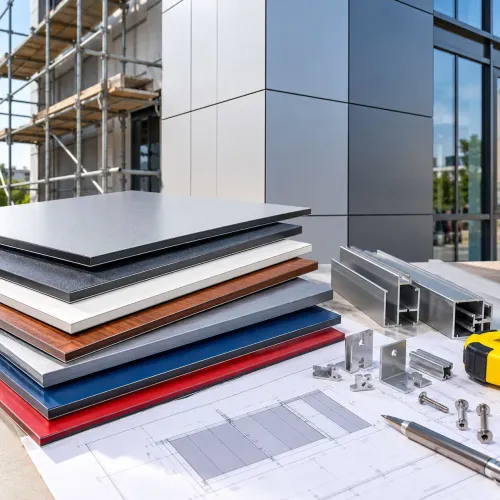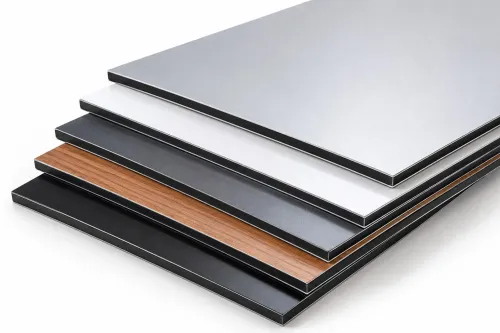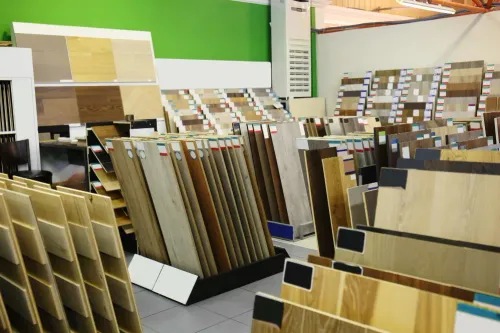
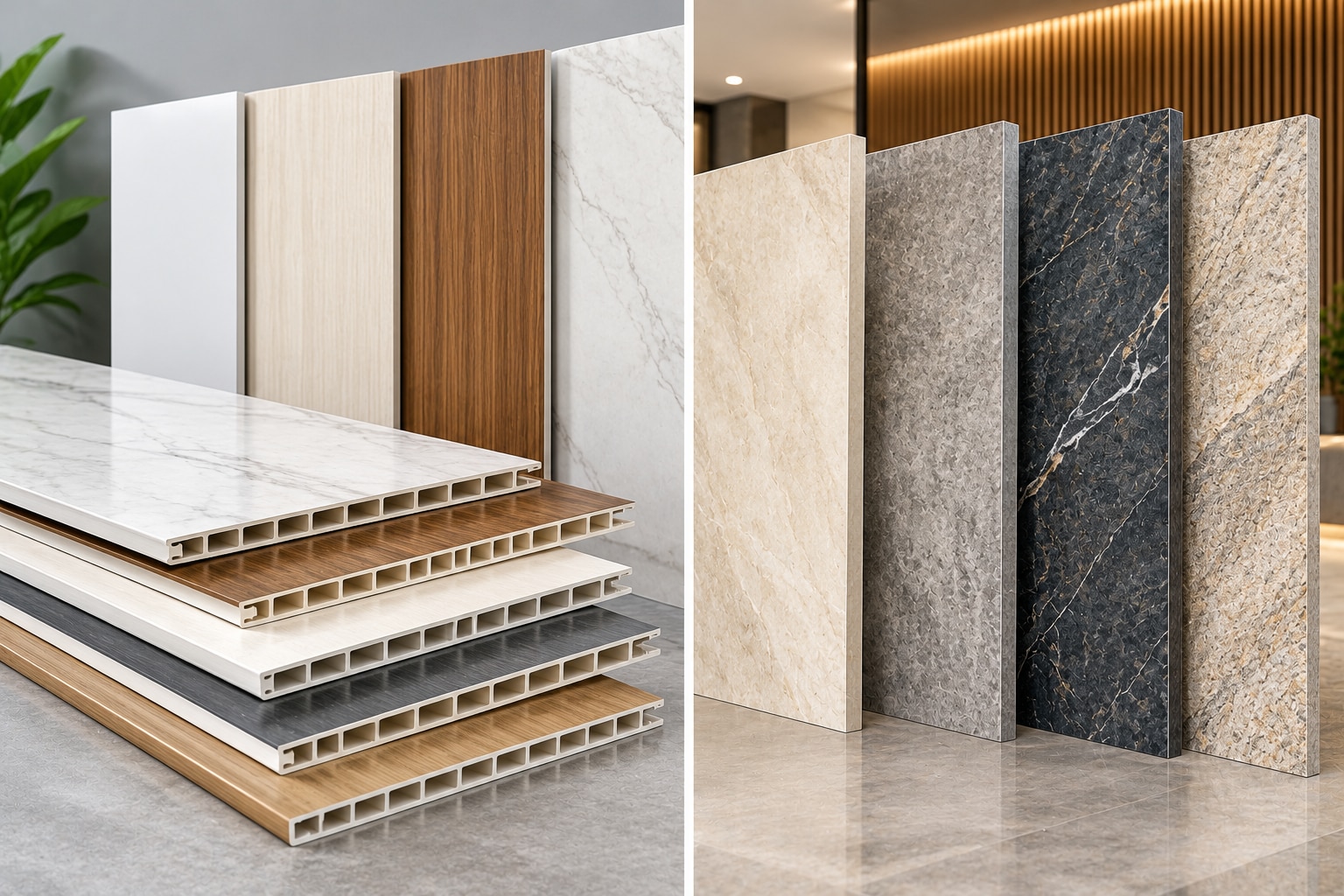
The right wall finish depends on more than appearance: substrate strength, moisture, heat, panel weight, installation disruption and future maintenance all change the decision. By comparing those factors against the conditions in your Pune renovation, you can choose a panel that performs well rather than one that only looks convincing in a showroom.
Key takeaways
- Choose WPVC for lighter handling and less renovation disruption.
- Choose stone when natural texture, permanence and structural support justify the extra load.
- Check the wall substrate before approving panel size, adhesive or mechanical fixings.
- Request samples, batch details, safety documents and local delivery terms.
Start with the material, weight and service conditions
A 20 mm natural stone panel weighs about 52–56 kg per square metre before adhesive, framing or mechanical fixings. That load changes the wall-panel comparison immediately: stone demands stronger substrate preparation and safer handling, while WPVC sheets reduce lifting, cutting and access problems.
| Option | Material and weight | Service conditions |
|---|---|---|
| WPVC sheets | Lightweight polymer sheets; confirm actual kg/m² and thickness on the datasheet | Moisture-tolerant walls, kitchens, bathrooms, corridors and fast renovations; check heat and fire limits |
| Stone panels | Natural or engineered stone with high rigidity; a 20 mm natural panel weighs about 52–56 kg/m² | Premium interiors, heavy-use walls and long service where authentic texture and scratch resistance justify stronger fixing |
| Both | Surface finish and performance depend on the exact product, joint detail and substrate | Do not approve from a showroom sample alone; test a sample on the actual wall |
WPVC resists routine moisture better than many porous stones and creates less cutting debris, but heat exposure, impact behaviour, acoustic performance and fire classification vary by construction. Stone tolerates abrasion and delivers genuine mineral variation, yet it adds transport, breakage and sealing concerns.
Natural slabs also require dry layout and shade selection; printed WPVC offers predictable colour but can repeat visibly.
For wpvc sheets or stone panels in Pune, inspect lift access, stair turns, storage protection, monsoon dampness and replacement stock before ordering. A flat wall is essential for stone, while thin WPVC can reveal waviness, screw heads or adhesive ridges after installation.
Match each panel to the room and the wall behind it
WPVC sheets perform better where low weight, quick cutting and moisture tolerance reduce renovation risk. Stone panels justify their extra weight and preparation when authentic texture, scratch resistance and long service life matter more than speed or easy removal.
| Option | Better room or wall | Why it fits |
|---|---|---|
| WPVC sheets | Bathrooms, kitchen backsplashes, corridors, rental upgrades and occupied commercial spaces | Lighter handling, repeatable appearance and less dust and disruption |
| Stone panels | Feature walls, reception areas, premium living rooms and high-contact commercial interiors | Natural variation, tactile depth, strong scratch resistance and a longer visual service life |
A 20 mm natural-stone panel weighs about 52–56 kg per square metre before adhesive, framing or mechanical fixings. That load demands a sound, flat substrate and a fixing system designed for the panel; an uneven wall can telegraph movement, open joints or cause debonding.
WPVC is the safer choice for incidental moisture, but it is not a waterproof wall by itself. Seal joints, corners, perimeter gaps and penetrations, then tie the detail into the bathroom or kitchen waterproofing system.
For either option, make a sample installation on the actual wall. It exposes waviness, adhesive ridges, screw heads, repeated printed patterns and stone shade variation before the full order. The best wall panels for renovation are the ones that match the wall’s condition, not merely the showroom finish.
Choose stone for visual and physical performance—not sound control. Both finishes need a tested acoustic backing or perforated system when noise reduction is required.
Compare installation time, fixing methods and renovation disruption
WPVC sheets are usually easier to install over an existing wall because they are lighter, quicker to cut and less demanding on the substrate. They still fail when they follow wall waviness, trap moisture or expose adhesive ridges, so preparation determines the result more than nominal installation speed.
| Option | Installation and fixing | Disruption and failure risk |
|---|---|---|
| WPVC sheets | Bond to a clean, dry, reasonably flat wall with the specified adhesive; use screws or trims where the system requires them. Cut with the recommended blade and finish joints and corners with compatible profiles. | Less dust, lighter handling and shorter curing time. Removal is simpler, but uneven walls, visible screw heads and poorly aligned joints show through. |
| Stone panels | Use the specified adhesive plus anchors, rails or reinforced backing when panel weight demands it. A 20 mm stone panel can weigh 52–56 kg/m² before fixings. | More lifting, cutting dust, storage protection and curing time. Weak plaster, gypsum board or damp masonry can release the panel if fixing relies on adhesive alone. |
Prevent later failure with this site sequence:
- Remove loose paint, dust and friable plaster; do not bond over wallpaper or a chalky surface.
- Check moisture, especially during Pune’s monsoon, and correct leaks before covering the wall.
- Verify flatness against the panel manufacturer’s tolerance and repair hollows before installation.
- Test substrate pull-out strength for stone, then specify anchors or backing for the calculated load.
- Approve a mock-up on the actual wall, including corners, joints and lighting, rather than accepting a showroom sample.
- Confirm delivery access, cutting space and replacement stock before work starts in an occupied building.
Judge the sample, finish and maintenance before approving a batch
A useful wall panel comparison starts with a mock-up on the actual wall, not a showroom sample. View WPVC and stone panels in daylight and artificial light, then inspect the same finish from two metres away and at arm’s length.
| Option | Appearance and joints | Cleaning, scratches and upkeep |
|---|---|---|
| WPVC sheets | Repeat patterns can look uniform; check grain alignment, colour variation and whether joints need trims or sealant. Thin sheets can reveal wall waviness and adhesive ridges. | Wipe with a soft cloth and pH-neutral cleaner. Test the actual finish because abrasive pads can dull it, and deep scratches are difficult to repair invisibly. Seal perimeter gaps in wet areas. |
| Stone panels | Natural variation, edge profile and joint width create the visual result. Check chipped corners, shade differences and lippage across adjoining panels. | Stone resists everyday scratching better, but porous varieties need sealing and prompt removal of stains. Use the cleaner specified for that stone; acids can etch some surfaces. |
| Both | Check a corner, penetration and internal joint, not only a flat face. | Ask how replacement pieces will match the installed batch and what the warranty excludes. |
Before approval, clean, scratch and join the delivery-batch sample:
- Rub it with the proposed cleaner and a white cloth.
- Make a light scratch test only on a sacrificial area.
- Inspect joints after drying, including corners and sealant lines.
- Request the technical datasheet, installation method, fire report, warranty exclusions and replacement-lot availability.
Use documented safety and local supply checks to make the final choice
Ask for evidence before you compare colour or price: the best wall panels for renovation are the ones whose composition, fire performance, installation limits and replacement supply fit your site. A showroom sample cannot prove that a panel suits a damp Pune wall, a commercial fire zone or a narrow staircase.
1. Ask a wpvc sheet supplier in Pune for the current technical datasheet. It must identify the core composition, density, thickness tolerance, water absorption, heat limits, fire classification and test method. “WPVC” alone is insufficient because it can describe PVC foam, wood–polymer composite or a PVC-faced board.
2. Ask a stone panel supplier in Pune for the same documents, plus panel weight, fixing requirements, sealing instructions and substrate flatness limits. Request a sample from the proposed delivery batch, not only a showroom piece, and check shade, pattern continuity, edges and joint alignment on your actual wall.
3. Get the installation method in writing: approved adhesive, mechanical fasteners, compatible primer, joint treatment, cutting tools, curing time and removal method. Ask for a fire report, warranty exclusions and written confirmation of lead time.
4. Confirm lift and stair access, protected storage during monsoon moisture, cutting-dust controls and replacement-lot availability. Ask how many matching panels they can supply later; natural stone needs batch selection, while repeated printed WPVC patterns need a dry layout.
National Veneer & Ply can help you compare WPVC sheets or stone panels in Pune against your wall condition, access route and maintenance plan. Reject any supplier who will not document these points.
Related product
 | WPVC Sheets & Stone Panels WPVC Sheets & Stone Panel View product → |
Frequently asked questions
Which is lighter: WPVC sheets or stone panels?
WPVC sheets are lighter and easier to lift, cut and position. A 20 mm natural stone panel weighs about 52–56 kg per square metre before adhesive, framing or mechanical fixings.
Are WPVC sheets or stone panels better for every room?
No. Match the panel to moisture, heat, impact and cleaning conditions, then check whether the wall can carry the finished system.
Which option causes less disruption during renovation?
WPVC sheets usually reduce lifting, cutting and access problems. Stone installation takes more substrate preparation, handling and fixing control.
What should you check before choosing a supplier in Pune?
Inspect a full-size sample, confirm the finish and batch consistency, request safety and product documents, and verify delivery, cutting and installation support.
Keywords